Vá para o link desejado:
Qualquer material que você queira colocar na página, mande para amiranda@tecgraf.puc-rio.br
|
http://www.mec.puc-rio.br/~edcmm/index.htm - Página da disciplina COMPORTAMENTO MECÂNICO DOS MATERIAIS (Departamento de Engenharia Mecânica da PUC/Rio). AMiranda recomenda - apostila sobre Mecânica da Fratura e Fadiga. |
|
Fatigue Damage Calculator - ViDa - This complete Damage Calculation Environment includes all the traditional fatigue design methods, and introduces a series of improvements to enhance the speed and the accuracy of the numerical results, e.g.:
ViDa's package includes the complete software, including a database with over 1500 materials, comprehensive user manuals and online help, and the new textbook "Fatigue Design Under Complex Loading". Please check our Photo Gallery for screenshots of the ViDa software, and Contact Us to learn how to get a free demo of ViDa. You can also check ViDa's user manual, or download the demo videos online. AMiranda recomenda |
Laços de Histerese - Programa feito em Maple que traça laços de histerese usando a relação constitutiva de Ramberg-Osgood, em carregamento complexo. O programa também calcula o dano de uma peça à fadiga. Funções internas: contador Rain-Flow, equações de modelos de dano, saída em arquivo texto dos resultados, saída dos dados do carregamento. Contribuição de Antonio Miranda. |
Propagação de Trincas 2D - Programa feito em Maple com as formulas de propagação de trinca superfíciais obtidas do livro do Anderson. Modelos de propagação estão presentes com contantes para os aços ferríticos. Contribuição de Antonio Miranda. |
|
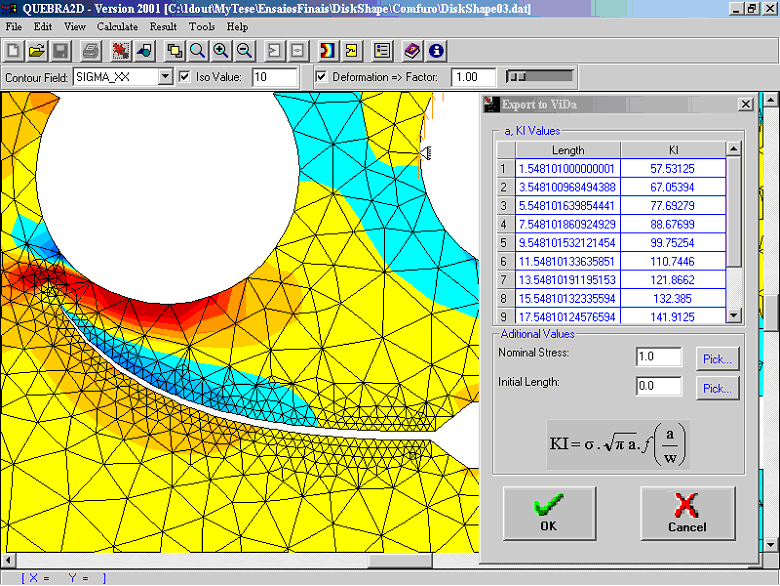
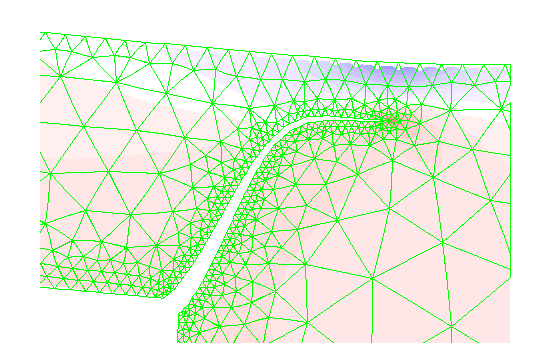
Imagens do Programa Quebra 2D - Programa que simula a propagação de trincas planas (retas e curvas) e que está sendo desenvolvido por AMiranda. |
|
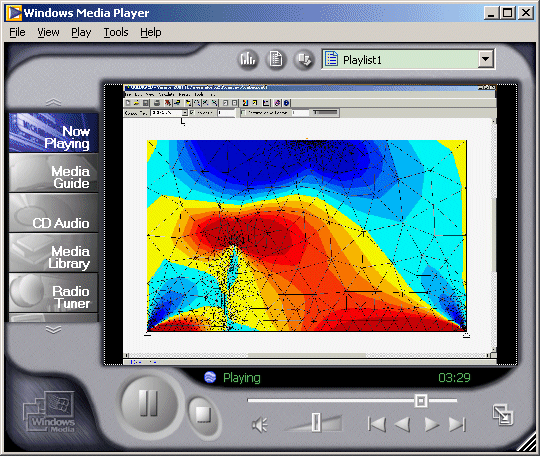
Vídeo do Programa Quebra 2D - Contribuição de Antonio Miranda. |
|
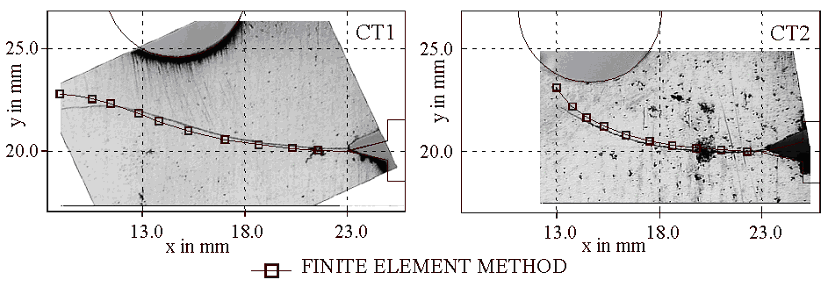
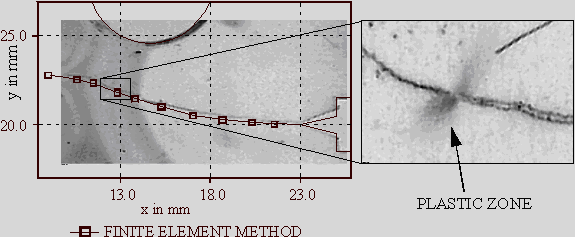
Imagens de resultados experimentais - Contribuição de Antonio Miranda. |
|
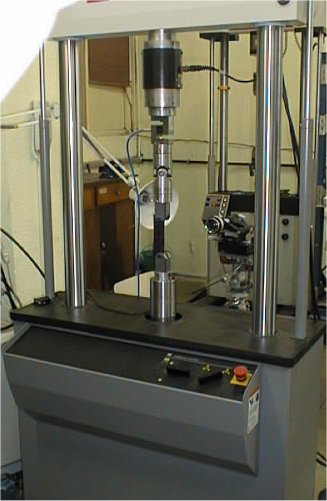
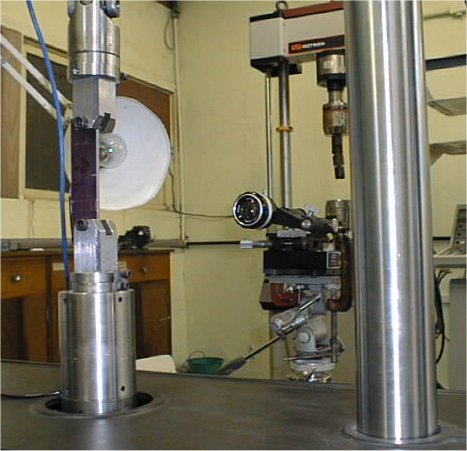
Imagens de uma máquina de máquina servo-hidraúlica (Lab. de Vibrações, PUC/Rio) - Contribuição de Antonio Miranda. |
|
WARP3D
- Static and
Dynamic Nonlinear Analysis of Fracture in Solids - WARP3D
is under continuing development as a research code for the solution of
very large-scale, 3-D solid models subjected to static and dynamic loads.
Specific features in the code oriented toward the investigation of ductile
fracture in metals include a robust finite strain formulation, a general J-integral
computation facility (with inertia, thermal, face loading), very general
element extinction and node release facilities to model crack growth,
nonlinear material models including viscoplastic effects, and the
Gurson-Tvergaard dilatant plasticity model for void |
|
Fatigue
Crack Propagation under Complex Loading in Arbitrary 2D Geometries
- Contribuição de Antonio Miranda |
Abstract: A reliable and cost effective two-phase methodology is proposed and implemented in two pieces of software to predict fatigue crack propagation in generic two-dimensional structural components under complex loading. First, the fatigue crack path and its stress intensity factor are calculated in a specialized finite-element software, using small crack increments. At each crack propagation step, the mesh is automatically redefined based on a self-adaptive strategy that takes into account the estimation of the previous step stress analysis numerical errors. Numerical methods are used to calculate the crack propagation path, based on the computation of the crack incremental direction, and the stress-intensity factors KI, from the finite element response. An application example presents a comparison between numerical simulation results and those measured in physical experiments. Then, an analytical expression is adjusted to the calculated KI(a) values, where a is the length along the crack path. This KI(a) expression is used as an input to a powerful general purpose fatigue design software based in the local approach, developed to predict both initiation and propagation fatigue lives under complex loading by all classical design methods, including the S-N, the e-N and the IIW (for welded structures) to deal with crack initiation, and the da/dN to treat propagation problems. In particular, its crack propagation module accepts any KI expression and any da/dN rule, using a DKrms or a cycle-by-cycle propagation method to deal with one and two-dimensional crack propagation under complex loading. If requested, this latter method may include overload-induced crack retardation effects.
|
Curved
Fatigue Cracks under Complex Loading
- Contribuição de Antonio Miranda |
Abstract: A reliable and cost effective two-phase methodology is proposed to predict crack propagation life in generic two-dimensional structural components under complex fatigue loading. First, the usually curved fatigue crack path and its stress intensity factors are calculated at small crack increments in a specialized finite element software, using automatic remeshing algorithms, special crack tip elements and appropriate crack increment criteria. Then, the calculated stress intensity factors are transferred to a powerful general purpose fatigue design software based in the local approach, which has been designed to predict both initiation and propagation fatigue lives by all classical design methods. In particular, its crack propagation module accepts any KI expression and any da/dN rule, considering sequence effects such as overload-induced crack retardation to deal with one and two-dimensional crack propagation under complex loading. Non-trivial application examples compare the numerical simulation results with those measured in physical experiments.
 Página sempre em construção.